
6-Examples for Loops and Program Control in C
C Programming Lessons, Learn C Programming, Introduction to C Language, How to Program with C
This course will examine more detailed example programs on structured programming, loops, and program control, covered in previous lectures.
For Loop Examples
/*****  Program to find the sum of all even numbers from 2 to 100  ****/

#include<stdio.h>

int main()
{
    int sum=0, number;  //defining variables

    for(number=2; number<=100; number+=2) //starting from 2 to 100 incresing 2 by 2
    {
        sum+=number;  //can be written also sum=sum+number ,
                      //each loop cycle adds every even number to sum variable
    }

    printf("Sum = %d\n",sum); //prints sum of the even numbers between 2-100

    return 0;
}
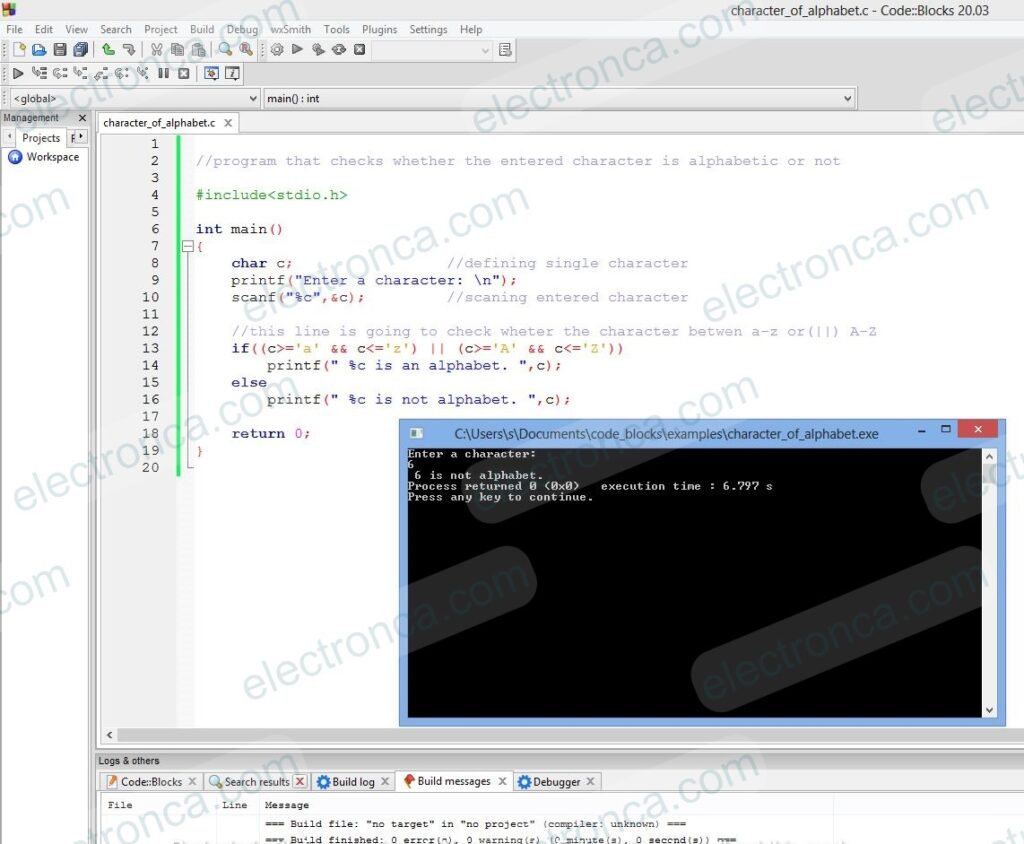
//program that checks whether the entered character is alphabetic or not

#include<stdio.h>

int main()
{
    char c;                 //defining single character
    printf("Enter a character: \n");
    scanf("%c",&c);         //scaning entered character

    //this line is going to check wheter the character betwen a-z or(||) A-Z
    if((c>='a' && c<='z') || (c>='A' && c<='Z'))
        printf(" %c is an alphabet. ",c);
    else
        printf(" %c is not alphabet. ",c);

    return 0;
}

/***program to print numbers, increasing number per line*////

#include<stdio.h>

int main()
{
    for(int i=0; i<=10; i++) // i increase to reach 10
    {
        for(int j=0; j<=i; j++) //nested for loop,
                                //j increase to reach i at every loop cycle
        {
            printf("%d ",j);
        }
    printf("\n"); // to pass one line below at each cycle of i
    }

    return 0;
}

While Loop Examples
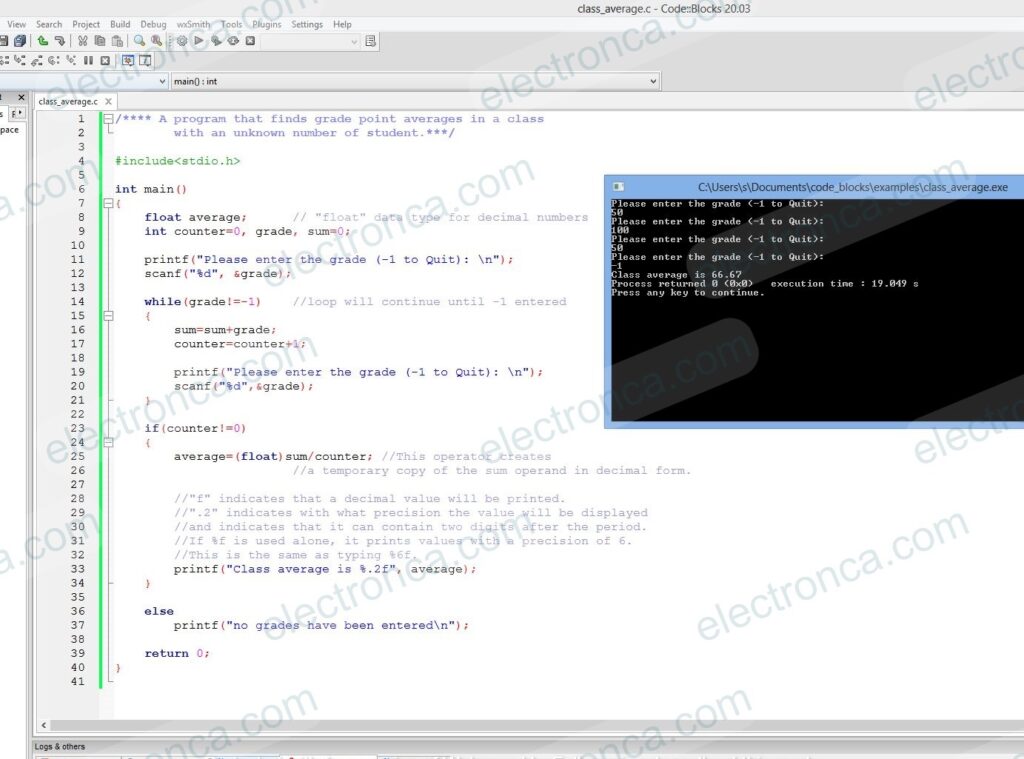
/**** A program that finds grade point averages in a class
        with an unknown number of student.***/

#include<stdio.h>

int main()
{
    float average;      // "float" data type for decimal numbers
    int counter=0, grade, sum=0;

    printf("Please enter the grade (-1 to Quit): \n");
    scanf("%d", &grade);

    while(grade!=-1)    //loop will continue until -1 entered
    {
        sum=sum+grade;
        counter=counter+1;

        printf("Please enter the grade (-1 to Quit): \n");
        scanf("%d",&grade);
    }

    if(counter!=0)
    {
        average=(float)sum/counter; //This operator creates
                        //a temporary copy of the sum operand in decimal form.

        //"f" indicates that a decimal value will be printed.
        //".2" indicates with what precision the value will be displayed
        //and indicates that it can contain two digits after the period.
        //If %f is used alone, it prints values with a precision of 6.
        //This is the same as typing %6f.
        printf("Class average is %.2f", average);
    }

    else
        printf("no grades have been entered\n");

    return 0;
}
/*********************************************
A course prepares students for an exam.
There is a list of 10 students.
It says 1 if he passed the exam, 2 if he failed.

Requested from us;
1) "Enter Result" message will be written
2) exam result numbers will be found
3) how many people passed and how many failed
4) If more than 8 passes, it will say "high success"

*****************************************************/

#include<stdio.h>
int main()
{
    int passed=0, failed=0, student=1, result;

    while(student<=10)
    {
        printf("Enter the result (1=pass,2=fail): ");
        scanf("%d", &result);

        if(result==1)
            passed=passed+1;    //counts passed number of students
        else
          if(result==2)
            failed=failed+1;    //counts failed number of students
        student=student+1;      //student counter
    }
    printf("%d passed\n",passed);
    printf("%d failed\n", failed);

    if(passed>8)
        printf("High success\n");
    return 0;
}

Switch Multi-Select Structure
Let’s explain the switch-case structure we mentioned in our 4th article with an example here.
An algorithm may include a number of choices, such as comparing a variable or expression with individual constants and performing different operations accordingly. C can make such selection structures with the switch multi-selection structure.
#include <stdio.h>

int main ()
{
   char grade; //defining variable

   printf("Enter your grade: \n");
   scanf("%c",&grade);  //saving entered grade


   switch(grade)
   {
      case 'A': case'a' :  //if grade in uppercase or lower case
         printf("Excellent!\n" );
         break;
      case 'B' : case'b':
      case 'C' : case'c':
         printf("Well done\n" );
         break;
      case 'D' : case'd':
         printf("You passed\n" );
         break;
      case 'F' : case'f':
         printf("Better try again\n" );
         break;
      default :
         printf("Invalid grade\n" );
   }

   printf("Your grade is  %c\n", grade ); // printing grade on screen

   return 0;
}

/***simple calculator with basic operations using switch-case***/

#include <stdio.h>

int main()
{
    int num1,num2;
    float result=0;
    char opr;    //to store operator choice

    printf("Enter first number: \n");
    scanf("%d",&num1);
    printf("Enter second number: \n");
    scanf("%d",&num2);

    printf("Choose operation to perform (+,-,*,/,%): \n");
    scanf(" %c",&opr);

    switch(opr)
    {
        case '+':
            result=num1+num2;
            break;

        case '-':
            result=num1-num2;
            break;

        case '*':
            result=num1*num2;
            break;

        case '/':
            result=(float)num1/(float)num2;
            break;

        case '%': //mod
            result=num1%num2;
            break;
        default:
            printf("Invalid operation.\n");
    }

    printf("Result: %d %c %d = %.3f\n",num1,opr,num2,result);
    return 0;
}

