
3-Operators in C Programming Language
C Language, C Programming, Code Blocks, Starting with C , Operators in C
In our previous article, we mentioned about arithmetic operators in C language.
In this article, we will cover “increment and decrement operators”, “assignment operators”, “relational operators”, ”logical operators” and “bitwise operators”.
Increment and Decrement Operators
Operators used for increment and decrement operations in C language are ” ++ ” and ” – – ” respectively. The result is increased or decreased by 1 according to the operator used.
//increment and decrement operators example
#include <stdio.h>

int main()
{
   int x = 5, y = 20;
   float a = 10.5, b = 100.5;

   printf(" ++x = %d \n", ++x); // 1 added to x
   printf(" --y = %d \n", --y); // 1 subtracted from y
   printf(" ++a = %f \n", ++a); // 1 added to a
   printf(" --b = %f \n", --b); // 1 subtracted from b

   return 0;
}
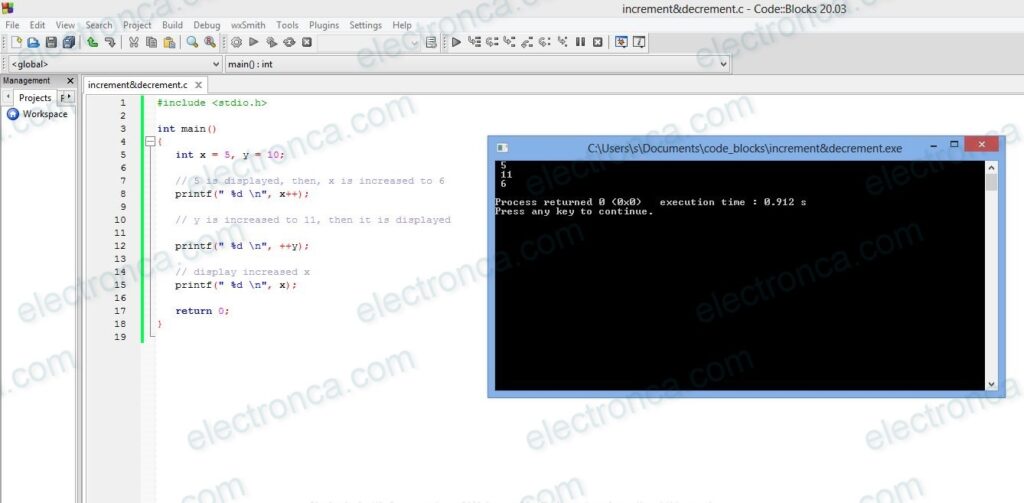
The order of operation results changes according to the location of the operators. The following example shows the difference using prefix and postfix.
#include <stdio.h>

int main()
{
   int x = 5, y = 10;

   // 5 is displayed, then, x is increased to 6
   printf(" %d \n", x++);

   // y is increased to 11, then it is displayed

   printf(" %d \n", ++y);

   // display increased x
   printf(" %d \n", x);

   return 0;
}
Assignment Operators
Operator Example Equal Expression
= x = y x = y
+= x += y x = x+y
-= x -= y x = x-y
*= x *= y x = x*y
/= x /= y x = x/y
%= x %= y x=x%y
/*Assignment Operators*/

#include <stdio.h>

int main()
{
    int x = 15, y;

    y = x;  // y is 15
    printf("y = %d\n", y);

    y += x; // y is 30
    printf("y = %d\n", y);

    y -= x; // y is 15
    printf("y = %d\n", y);

    y *= x; // y is 225
    printf("y = %d\n", y);

    y /= x; // y is 15
    printf("y = %d\n", y);

    y %= x; // y = 0
    printf("y = %d\n", y);

    return 0;
}

Relational Operators
Operator Equivalent in C Example Equal Expression
= == x==y x equals to y
≠ != x!=y x is not equal to y
> > x>y x greater than y
< < x<y x is less than y
≥ >= x=>y x is greater than or equal to y
≤ <= x<=y x is less than or equal to y
If the condition is true, the statement in the “if” structure is executed, otherwise it is not executed.
// example__relational operators

#include <stdio.h>

int main()
{
    int x = 10, y = 10, t = 15; //defined variables

    //system will print 1 (true) if the condition is met, otherwise it will print 0 (false)

    printf("%d == %d is %d \n", x, y, x == y);

    printf("%d > %d is %d \n", x, y, x > y);
    printf("%d < %d is %d \n", x, t, x < t);

    printf("%d != %d is %d \n", x, y, x != y);

    printf("%d >= %d is %d \n", x, y, x >= y);

    printf("%d <= %d is %d \n", x, t, x <= t);

    return 0;
}
Logical Operators
Operator Equal Expression Example
&& True only if all operands are true if x=4 and y=2, ((x==4) && (y>5)) equals to 0
|| True only if either one operand true if x=4 and y=2, ((x==4) || (y>5)) equals to 1
! True only if the operand is 0 if x=4 , the expression !(x==4) equals to 0
Bitwise Operators
Operator Equal Expression
& Bitwise AND
| Bitwise OR
^ Bitwise Exclusive OR
~ Bitwise Complement
>> Shift Right
<< Shift Left
